Your House Is Listening: How Smart Devices Are Weaponized in Coercive Control
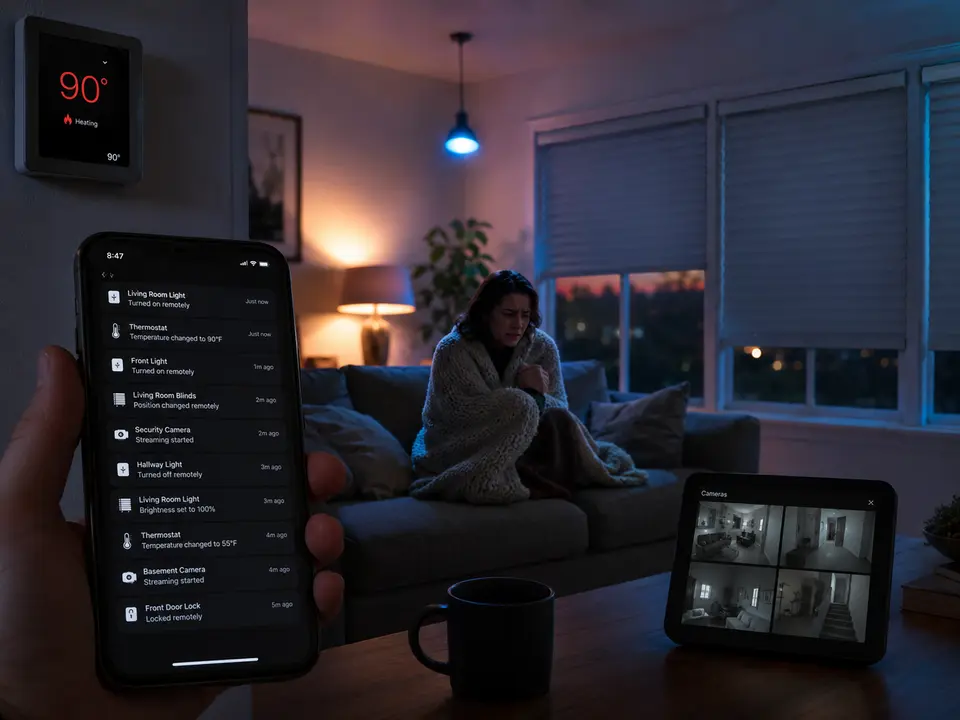
You wake up at 3am and your house is freezing. The thermostat reads 55 degrees. You set it to 70 before bed, like you do every night. You walk down the hallway, adjust it back, and crawl under the covers. Twenty minutes later, your bedroom light turns on by itself. At 4am, your phone buzzes with a doorbell camera notification. You pull up the live feed. There's no one there.
Your ex moved out eight months ago. He doesn't have a key. He doesn't even live in the same state.
But he set up the smart home three years ago. And he never gave up the app.
This is the modern reality of coercive control. We are living in a real-time version of the movie Gaslight, except the abuser doesn't have to be physically present to move objects, change the temperature, or unlock the door. Smart devices have given abusers a new toolkit — persistent, deniable, and terrifyingly effective.
In this post, we're breaking down how smart technology is being weaponized in domestic violence and coercive control, the five most common tactics abusers use, how AI is accelerating the threat, and a step-by-step framework for what survivors can actually do.
What Counts as "Smart Tech" in an Abusive Relationship
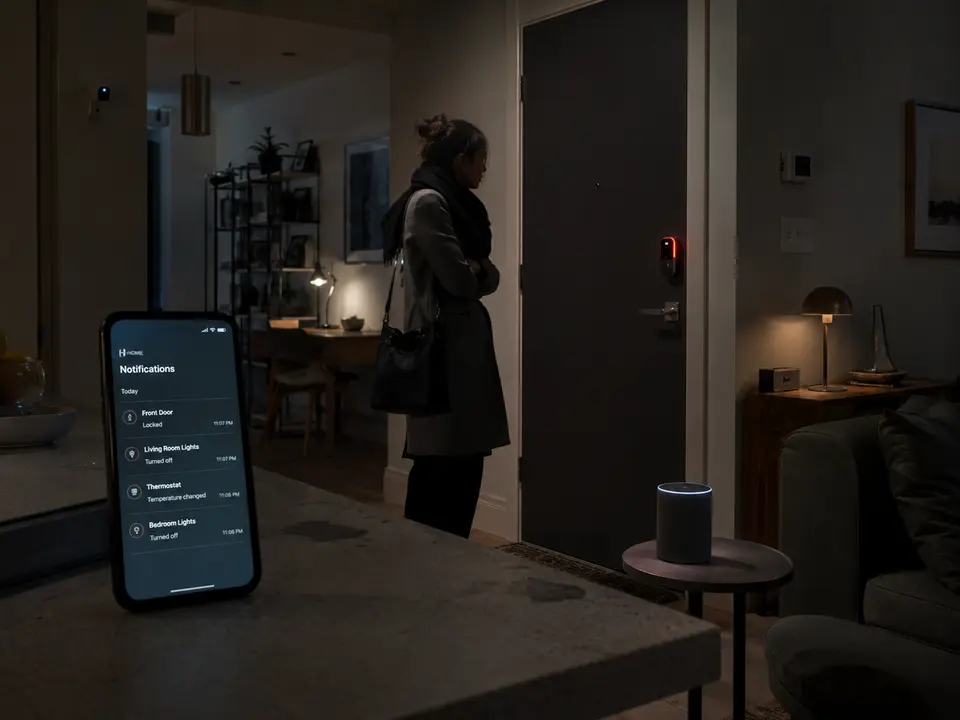
When we say "smart home," we're talking about an entire ecosystem of connected devices. Most people don't realize how much of their daily life sits inside this ecosystem until they try to leave a relationship and discover that everything around them has a login attached to it.
Here's what's typically in play:
Smart locks — the kind you can unlock from your phone, anywhere in the world.
Cameras — doorbell cameras, indoor cameras, nanny cams, outdoor security cameras. Most of them record audio. Many have two-way audio, which means whoever controls them can also speak through them.
Thermostats — controllable remotely, with full logs of every adjustment.
Smart lights — on, off, color, brightness, schedule. All controllable from an app.
Smart speakers — Alexa, Google Home, Apple HomePod. Always listening for a wake word, but also creating logs of what's said to them and what's played through them.
Connected cars — most cars built in the last five years come with apps that show location history, allow remote locking and unlocking, and sometimes even allow the engine to be disabled.
Family plan accounts — Apple Family Sharing, Google Family, cell phone plans, shared streaming accounts. Each of these shows usage data: what was watched, when, and where.
Small tracking devices — Apple AirTags, Tile trackers, generic GPS units the size of a quarter that cost twenty dollars on Amazon.
What makes all of this uniquely suited to coercive control isn't any single device. It's the combination of three properties:
These tools are persistent — they run twenty-four hours a day without anyone having to do anything.
They're deniable — the abuser can always say, "I didn't do that, must be a glitch."
And they were almost always set up during the relationship, when things looked fine. The abuser is the administrator. The survivor is a user on someone else's system, inside her own home.
Researchers now have a term for this: intimate partner surveillance. Not stalking by a stranger. Surveillance by someone who knows your routines, your passwords, your patterns, your kids' schedules. Someone who built the system around you while you were sleeping next to them.
That is what survivors are dealing with.
The Five Tactics Abusers Use with Smart Devices
These five tactics come up over and over in domestic violence advocacy work. Some of them sound almost cartoonish on paper. They're not. They're happening in ordinary suburban houses right now.
Tactic 1: Surveillance Disguised as Security
A couple installs a Ring doorbell. Sensible. Then indoor cameras "for the dog." Then a camera in the garage. Then one pointed at the driveway. Then one pointed at the backyard.
By the time the relationship deteriorates, the abuser has a real-time feed of every entrance and exit. He knows when she leaves for work. When she gets home. Who comes over. How long they stay. You might not see it, but this is a high control relationship.
After separation, if he still has app access — and he very often does, because nobody thinks to change it — he has the same feed. He's watching his ex live her life, in high definition, from far away.
Tactic 2: Harassment Through Environment
Lights flickering. Heat dropping. Music suddenly blasting from a smart speaker at 2am. The TV turning on by itself. The robot vacuum starting at 4am.
This serves two purposes.
One: sleep deprivation, which is a recognized form of psychological torture. An exhausted person can't make good decisions. An exhausted person is worn down. An exhausted person is easier to manipulate.
Two: making the survivor feel insane. When your environment behaves erratically and no one believes you, you start to doubt your own perception of reality. That doubt can then be weaponized to erode your identity, isolate you further, and keep you in a psychological prison — even if you can't prove you're being watched, you start to behave as if you are.
Tactic 3: Tech-Enabled Gaslighting
"I didn't change the thermostat."
"There's no way I could be controlling the lights."
"Maybe the system is glitching. Have you tried calling the company?"
Every one of those statements is technically plausible. Smart home systems do glitch. The abuser is gaslighting the victim by exploiting that plausible deniability.
Tactic 4: GPS Tracking and Stalking
This is where AirTags and other location trackers come in. The stories are not abstract:
- AirTags sewn into the lining of a child's backpack — so the abuser knows exactly where the child is at all times, which also means he knows where the mother is during custody exchanges and afterward.
- GPS trackers magnetically attached to the undercarriage of a car — twenty dollars on Amazon, battery lasts weeks. Survivors often discover them only when they take the car in for an oil change.
- Connected car apps — and this one is especially sneaky. If your name isn't on the loan or the original account setup, you might not even know the app exists. The abuser pulls up his phone and sees every place the car has been in the last thirty days: where she works now, where she's staying, the address of the new lawyer's office, the new partner.
The car becomes a snitch.
Tactic 5: Using Children's Devices
The abuser sends the child back to the survivor's house with an iPad. The iPad is on the abuser's Apple ID. It records audio. It tracks location. The child has no idea. The survivor doesn't think to check — because it's a kid's tablet.
Or the child receives a "gift" of a smart speaker for their room at mom's house. Set up by dad, on dad's account. The abuser knows what the child is searching, what the child is asking, what the household sounds like during dinner.
Children become unintentional conduits — and the survivor often doesn't realize for months.
The New Layer: How AI Is Accelerating Smart Tech Abuse
Artificial intelligence doesn't magically see into your home. But when an abuser already has access — to your Apple ID, your Google account, your Amazon, your Ring, your Nest, or a compromised Wi-Fi router — AI makes all of the above easier, faster, and more sophisticated.
AI can:
- Summarize footage from cameras, so the abuser doesn't have to watch hours of video — they just get a digest.
- Recognize patterns in your movements, sleep schedule, who visits, and when. AI is exceptionally good at pattern recognition.
- Transcribe audio from smart speakers or recordings, making them searchable.
- Create sorting logs like a database of your daily life.
- Automate alerts — pinging the abuser the moment you do something outside your normal routine.
What AI is really doing is taking the legwork out of surveillance. It's lowering the effort required to monitor someone. And as these tools become cheaper and more accessible, the barrier to abuse drops further.
What Survivors Can Actually Do
If any of this resonates, please know: there is a path forward. But the order of steps matters. Doing the right things in the wrong order can escalate the danger.
Before you do anything else, consider reaching out to a domestic violence organization that does tech safety work. The National Domestic Violence Hotline can connect you. The NNEDV Safety Net Project has free, detailed resources. Refuge in the UK has a dedicated tech abuse team. Links are at the bottom of this post.
That said, here's the general framework.
Step 1: Take Inventory Before You Act
Don't change anything yet. Make a list.
- Every smart device in the house
- Every app on your phone
- Every shared account
- Who set it up
- Whose email is the administrator account
- Whose phone gets the alerts
If you can, do this somewhere private. Not in front of the device. Smart speakers hear you.
Step 2: Assess the Risk of Being Noticed
This is the step most articles skip, and it's the most important one.
If you suddenly kick someone out of the Nest account, they will get a notification. They will know you know. That can be the most dangerous moment in an abusive relationship — the moment the abuser realizes they're losing control.
For some, the right answer is to make changes quietly, gradually, and only after they're physically safe. For others, the right answer is to leave everything in place, get out, and then deal with the tech. Some survivors need to keep certain things in place temporarily to avoid tipping off the abuser while planning their exit.
There is no universal right answer. This is exactly why advocates exist.
Step 3: Document Everything
- Screenshots of weird notifications
- A log of incidents — date, time, what happened
- Photos of any GPS devices you find (don't remove them immediately if you can help it — document first, ideally with a witness, ideally with law enforcement notified)
This documentation is what makes the difference in family court. Judges who would otherwise dismiss tech abuse as paranoia respond differently to a calendar of forty-seven incidents over three months with corresponding screenshots.
Step 4: New Device, New Account, New Everything
When you're ready and safe, the gold standard is:
- A new phone
- A new Apple ID or Google account
- A new email address
- A new phone number
- A new network the abuser has never had access to
Treat your old devices as compromised — because they probably are. This is expensive and disruptive. It is also, often, the only way to start over cleanly.
Step 5: Sweep Your Physical Space
For AirTags and Bluetooth trackers, both iPhones and Android phones now have built-in scanning. Walk through your car, your bags, your kids' belongings.
You can also buy dedicated RF detectors for under a hundred dollars that pick up active transmitters. Check the undercarriage of your car. Check inside the bumpers. Check inside stuffed animals that came from the abuser.
I wish I were exaggerating. I'm not.
To Friends and Family Members
If someone in your life is describing this kind of abuse to you — please believe them.
The single most common thing survivors say is that when they first started describing what was happening, the people around them thought they were losing it. The tech sounds science-fiction. It isn't. These are two-hundred-dollar consumer products being used exactly as designed, by someone who knows the survivor better than anyone else does.
Believing her is the first thing you can do. Helping her find a tech safety specialist is the second.
Resources and Hotlines
If you're experiencing tech-enabled coercive control or domestic violence, the following organizations specialize in this exact form of abuse:
United States
- National Domestic Violence Hotline: 1-800-799-7233 (call) or text "START" to 88788. Trained advocates available 24/7, including for tech abuse situations.
- NNEDV Safety Net Project: techsafety.org — free, detailed resources on tech-facilitated abuse.
United Kingdom
- Refuge Tech Safety: refugetechsafety.org — dedicated team for tech abuse cases.
- National Domestic Abuse Helpline: 0808 2000 247 (24/7, free)
Canada
- Assaulted Women's Helpline: 1-866-863-0511 (24/7, free, multilingual)
- Ending Violence Association of Canada: endingviolencecanada.org
Australia
- 1800RESPECT: 1800 737 732 (24/7 national counselling service)
- WESNET Safety Net Australia: techsafety.org.au
A safety note: If you've been reading this on a device an abuser may have access to, consider clearing your browser history. If you listened to this episode on a smart speaker, the play history is in the app.
Take care of yourself. Take care of each other.

Host
Hi, I'm Brandon Chadwick!
In 2019, I began interviewing survivors of narcissistic and domestic abuse on my podcast, Narcissist Apocalypse. In that time, I've published over 120 survivor stories, interviewed countless experts in the field, from therapists, to lawyers, to domestic violence advocates and agencies.
My philosophy for the podcast was to be different, and to me, that meant to be real, not clinical. My goal was to help survivors tell/validate their own stories, but to also validate and teach other survivors through those stories. And a crazy thing happened, it worked.
Narcissist Apocalypse has grown beyond my wildest dreams. It now reaches upwards of 10,000 listeners an episode and it keeps growing every day. If you read the reviews on Apple Podcasts, you can see just how much of an impact the show has made in the lives of our community members. Yes, we are now a community.
Narcissist Apocalypse has evolved into something bigger. We've taken the philosophy of the podcast and have extended it to power our support groups. Narcissist Apocalypse isn't just me anymore. We are now a community. And that community is here to support you at every step of your healing process and beyond.
Being part of your lives and watching people grow in our support groups has been quite an honor. So I just wanted to say thank you. Thank you for sharing. Thank you for listening. And a big thank you for helping everyone feel less alone. Welcome to our community.
With Much Love,
Brandon Chadwick