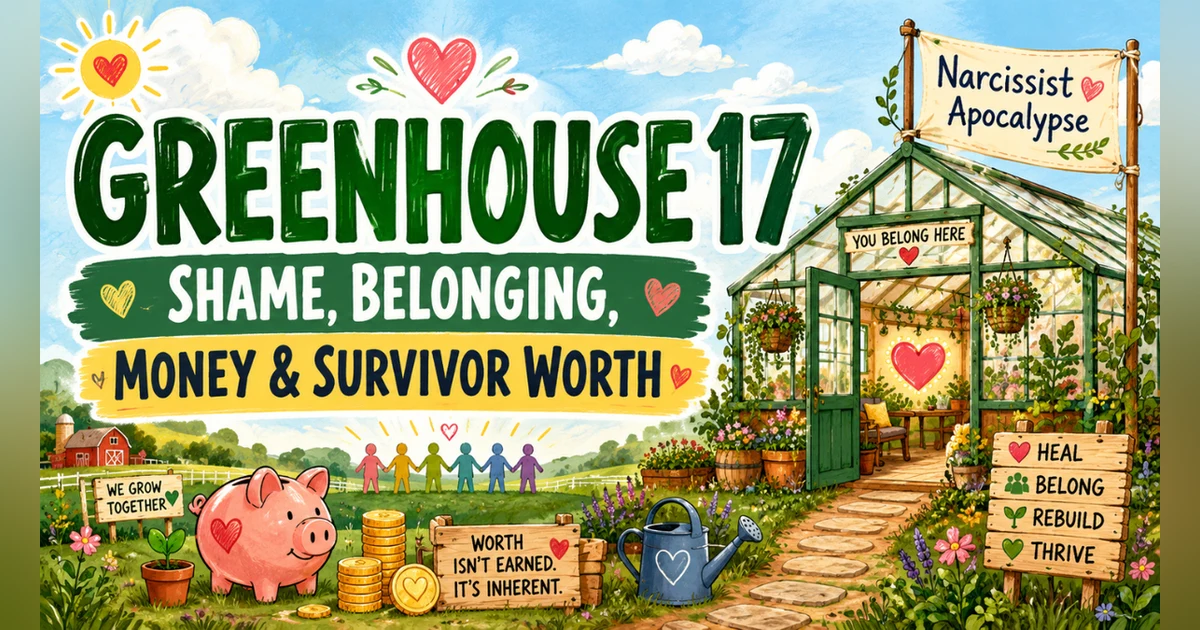
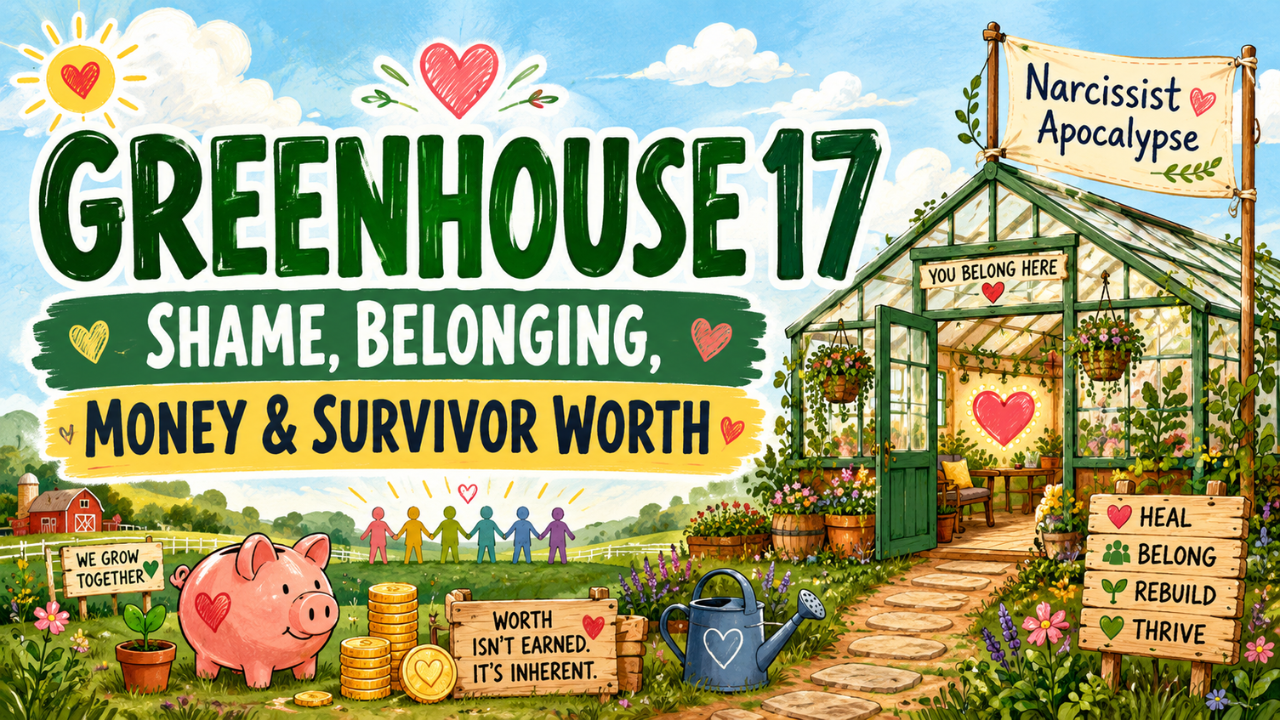
Greenhouse 17: Shame, Belonging, Money, and Survivor Worth

 Apple Podcasts
 Spotify
 Castro
 RSS Feed
 In this episode of Narcissist Apocalypse, Brandon talks with Darlene Thomas, Executive Director of Greenhouse17, a domestic violence shelter and advocacy program in Kentucky built on a 40-acre farm. Darlene shares how Greenhouse17 reimagined shelter by moving away from shame, secrecy, rigid rules, and one-size-fits-all support.
Together, they discuss survivor shame, community belonging, financial abuse, economic repair, and why safety is only one part of rebuilding after abuse. Darlene explains how abusers can trap survivors through ruined credit, stolen identities, unpaid debts, lost income, and financial dependence, and how Greenhouse17 helps survivors begin repairing those pieces through education, support, stipends, and survivor-centered care.
This conversation is also about worth. It is about what can happen when survivors are treated as people with value, not problems to manage. Through farming, flowers, handmade products, community connection, and grace, Greenhouse17 offers a model of shelter where survivors are supported, trusted, invested in, and given room to grow.
Click here to learn more about Greenhouse17.org
To download the financial handbook mentioned in this episode -> CLICK HERE
CLICK HERE if you want to be a guest on our survivor story podcast, please send us an email at narcissistapocalypse@pm.me
Click on the title to read about Coercive Control as Care: Signs & Patterns
Sign up to our Domestic Violence Newsletter
Hosted by Simplecast, an AdsWizz company. See pcm.adswizz.com for information about our collection and use of personal data for advertising.
Brandon Chadwick (0:00): On this episode of Narcissist Apocalypse, we talk with Darlene Thomas, Executive Director of Greenhouse seventeen about shame, belonging, money, and survivor worth. Welcome to Narcissist Apocalypse, everyone. I am Brandon Chadwick and today with us we have Darlene Thomas who is the Executive Director at Greenhouse seventeen. How are you?
Unknown Speaker (0:52): I am doing really good.
Brandon Chadwick (0:55): Well, thank you for being here. I found you on the Internet. I was searching around and you're located in Kentucky at greenhouse17.org. And I was researching like different alternatives to Shelters that are out there, just doing my own research. Shelters just might be doing things that are a little bit different, a different outlook, a different philosophy on things from what the shelter system currently looks like and not just how the Shelter works, but just like the philosophy of how Survivors view themselves.
Brandon Chadwick (1:30): And I found what you were doing really interesting. Greenhouse seventeen is part Farm, part shelter, lots of interesting ideas, programs, and today, my hope is that you Darlene can inspire someone out there to start building more facilities like Greenhouse seventeen. You're also going to impart a lot of knowledge today about a little bit about shame and what shame is here when it comes to the shelter system, as well as a little bit on on financial abuse as well. So just a big thank you for for being here. And before we get into anything about Greenhouse seventeen, who are you?
Brandon Chadwick (2:09): How did this all begin? And then we'll get to Greenhouse seventeen, the evolution in the philosophy and everything there.
Unknown Speaker (2:18): Wow, who am I? I am now a thirty six year advocate in this field working in domestic violence. And I have to say that is the part of who I am because it is definitely what I was supposed to do. You don't know your path. I just happened to get hired at the very first place.
Darlene Thomas (2:39): I needed a big girl job way back when. They said they were hiring in a spouse abuse center. And I'll be really honest with you, I didn't even know what a spouse abuse center was because it was so early in the movement. You know, this was the late 80s. The movement was fairly new.
Darlene Thomas (2:54): So I've really grown up in this work. So you see a whole lot of what worked, but I come from a very grassroots philosophy. I remember the days where everything we did was in partnership with survivors. That we were experiencing the courts the same way. I may not have been the survivor, but I was harassed and bothered and talked to the same way survivors were back then.
Darlene Thomas (3:16): We weren't allowed to be in courts. We would get kicked out of systems. We were blamed. We were called names. You name it.
Darlene Thomas (3:24): And we were very much seen as these outsiders of people trying to have an impact for survivors and their kids. So I kind of grew up in this work, in this movement, and have seen it change over the years. But in that, I've seen kind of what worked and what didn't work. And many years later, about fifteen years into doing domestic violence services, I had the opportunity to maybe be a part of something new and different because a former program in our area, in our state, in Lexington, Kentucky, which is where Greenhouse seventeen is, that organization, the prior one, was basically losing all of its funding by the Funders Choice. And we knew there had to be a replacement organization.
Darlene Thomas (4:09): So I just thought, you know what, what a great time to try to figure out how to start something new and really keep it grassroots and also professional, but never lose sight of why we do this work and that's survivors. And that's kind of where Greenhouse seventeen was born, was kind a Phoenix rose from the ashes. There was a lot of groundwork and building that had to be done. It wasn't easy by any means. But it has been a pretty beautiful journey thus so far and I think we've landed in spaces that don't just talk about trauma informed, that actually practice it.
Brandon Chadwick (4:51): So, you were in this for a long time and you saw what worked and what didn't work. So, what was the philosophy that you created here or help with other people? Because also, this is Survivor led in the sense of you're listening to survivors. You're not going top down. You're kind of going, you're equal just like us.
Brandon Chadwick (5:17): We're going to listen to you because what a lot of people who listen to our show and other places, we try to instill the fact that like, Survivors don't realize they have value and that their ideas are good and you know, their experience is worth something going forward. So, kind of tell us how your philosophy rose out of these people.
Darlene Thomas (5:42): Well, know, it was really just to embrace. Like, we wanted to redefine survivors in lots of ways for themselves, not us doing it. But in that redefinition, we knew we had a responsibility to the community to try to build these bridges where survivors were celebrated and seen, not hidden away. So one of the first things we did is we chose not to be a confidential location, which was quite controversial twenty two years ago. And more and more shelters are moving in that direction today.
Darlene Thomas (6:13): But for years, all these shelters were hidden and confidential and survivors weren't allowed to have visitors or tell where they were. They have to walk down the block to meet people or catch rides. A lot of rural driven kind of expectations often kind of veiled in this perception of confidentiality and privacy and safety. And the thing that Greenhouse really wanted to challenge is that the vast majority of our community is not what's unsafe for survivors. It's our job to help keep survivors safe from the person who's done harm to them.
Darlene Thomas (6:47): But survivors need community and a sense of belonging in order to begin to heal from that journey. And so why would we isolate them from the people that are going to be the ones that help carry them through in the future? Right? So we let ministers come and visit. We let family members, brothers, sisters, moms, come and visit and be a part of it.
Darlene Thomas (7:10): We allowed community groups to come in and be part of our farm. One thing about Greenhouse seventeen, we also located ourselves on a 40 acre farm because we wanted to make sure that rural survivors had access and felt comfortable going to a shelter instead of going to an urban core, which many of my rural communities would never have been comfortable with, so that people all had access throughout the people that we were serving. So we kind of started with this idea of inclusivity, surrounding survivors with lots of love and care until they learn to love and care for themselves. Making sure we didn't isolate them from the people that were most important to them, or the values that they valued to be a part of their life, whatever that would look like. And then out of that kind of grew this sense of really good.
Unknown Speaker (8:02): We need rules. Like we don't need rules. These are adult survivors. I mean, we all need guidance, but we just need some basic guidelines to follow just out of respect for one another. I'm not gonna give you a curfew, but please give me a call if you're gonna be past nine because I'm gonna worry about you and I'm gonna worry about your safety because we know what happens with domestic violence.
Darlene Thomas (8:23): We know batters are still going to show up at your workplace and show up at your kid's school and they're going to show up at your parents' house and all those things. So it's just this matter of how do we create a relationship, this journey with the survivor, so that we have enough trust to know what our intention is only to keep you safe and hear you and be present for you. Your intention, if you will allow us, is to give us some room to trust us to do that with you. Which is hard, but we try to do that. And it takes time and it's not easy.
Darlene Thomas (8:55): So one of our philosophies was grace. We weren't going to exit people. We weren't going to just kick people out for being imperfect or making mistakes or not follow rules. Cause we decided not to have rules. So that kind of defeated it.
Darlene Thomas (9:08): But I'm not gonna say it was a free for all. There are basic human decency guidelines we all needed to kind of follow. But we knew that survivors would do things imperfectly. They've been stripped of their power. They've been stripped of a lot of their control and their own decision making.
Darlene Thomas (9:25): So it takes time to learn how to do that again. It doesn't happen overnight. So we got rid of length of stays and we just kind of did groups and we listened to survivors and they told us. Then, I don't know, one day we were on this farm and there was a lot of financial things going on in our country. And we thought about how we could utilize the farm and all this property.
Darlene Thomas (9:49): And it's just evolved since then. So it was stripping out what most shelters had kind of professionalized, you might say, I will quote those air quotes, into becoming in the context of safety that we just really didn't feel benefited survivors. And that survivors weren't telling us that they didn't want visitors and that they wanted curfews and that they wanted three strikes you're out. Nobody was telling us any of that stuff. But that's what was happening in many, many shelter programs across the country.
Darlene Thomas (10:28): They became very rigid and strict, and so only the most amenable survivors were successful in those programs. But people struggling with other issues, mental health, substance abuse, human trafficking backgrounds, all these other issues that played into their life did not always make them conducive in the beginning to be perfect residents, if that makes sense.
Brandon Chadwick (10:52): And when I think of someone who has an addiction and goes to let's say a rehab facility, you're kind of in there And the most difficult thing for someone who's in those facilities isn't necessarily the time in there, it's when they leave, you know, they've been in such a cocoon away from everything and being able to do things. So when they do go back out into the world, that it's less of a huge jump per se, that there's support that is already kind of with them on this journey that has surrounded them. So they're kind of going out in the world with a little bit of a protective bubble that's been built in, as well as if they want, you have a farm and they can one, get skills but that might not be the biggest thing, but just interacting with the farm and feeling like someone has value in other different ways. So, can you kind of tell us about how the farm comes in, how not everyone has to participate if they don't want to, but the idea of what that can do for people?
Darlene Thomas (12:19): So I think what we were hearing and continue to hear from survivors is choices and options, things that lend to them and their strengths. So what we decided to do a little bit was to begin to explore multiple ways that survivors could access instead of the traditional sit down support group kind of thing. Which is lovely. It works for lots of people. It doesn't work for everybody.
Darlene Thomas (12:46): So if you came to our building now, you would see a wonderful art room where great community art, different things are happening. People have access to it all the time. Some people express that way. At one point in time, we had a yoga room, although we still do those kinds of pieces where some people find some peace and quiet through yoga. I have a whole wall of ukuleles.
Darlene Thomas (13:08): And we do ukulele group around here because some people like music. And it's just a way that they feel and come about. So constantly providing options for opportunity. And so one way we did that is we started a farm. And because there was some accounts when you look at post traumatic stress disorder, and you look at the military and veterans, that horticultural therapy, that kind of farming gardening was showing, the research was showing it might have some positive impact on that kind of trauma.
Darlene Thomas (13:41): Nobody had looked at domestic violence in that kind of trauma on multiple levels. They also don't look at it when you look at brain injuries either, which often occur for domestic violence survivors. However, for us at that time in Kentucky, it was an economically hard time and it was all about Kentucky Proud and buy local. That was the theme. Everything you saw on our media was buy local, be proud, help your local farmers, help your local entrepreneurs do their thing.
Darlene Thomas (14:13): And so we kind of capitalized on that a little bit with our survivors. And we started growing food out of box gardens, which wasn't completely successful at that moment, but we tried something. Survivors liked it. The kids liked it. And it was better to eat some lettuces than it was to have processed food all the time, which is what most shelters feed people because it's what's affordable.
Darlene Thomas (14:37): It's not good for us, but it's what's affordable. Slowly that next year we hired a farmer and we started growing poundage. And the next thing you know, people in Appalachia, one of the colleges heard about what we were doing and they connected us with a man named John Paul DeGioria, which most people in The States, I'm not sure about where you're from, but Paul Mitchell Hair Care Products. I don't know if you all have those where you're from. But he's big in The United States when he heard about us and he has a foundation called Grow Appalachia.
Darlene Thomas (15:08): And he helped fund our first farmers when we started growing food here. But what was happening wasn't just healthy food. It was this sense of belonging of the residents. The residents were just out there getting dirty, picking things, planting things, harvesting them. And they started to write about it and talk about the impact it had on their mental health and their well-being and their just sense of belonging and having quiet.
Darlene Thomas (15:35): And then we just started to witness this organic way that survivors talk to each other, related to each other, that wasn't formal. It was so informal, but it was beautiful. It was compelling. We weren't having to do the work. They were doing their own work with each other.
Darlene Thomas (15:54): It wasn't us. We were just these bystanders watching what organically can take place if you give people opportunity for that to happen. And then we moved into trying to think about how we could earn money as an entity, as an agency, the same time making sure our survivors. So what would benefit them and us, right? But all of us together in this together.
Darlene Thomas (16:19): And so we started a flower industry and we pay stipends to survivors. We also make body products like lip balms and soaps. It's called Handmade by Survivor products. They've been sold in almost all 50 states and a few countries over the last several years. Survivors get to be a part of all or any of it or none of it.
Darlene Thomas (16:39): It's all up to them. But the vast majority do participate. They love learning how to do self sufficient things like make soaps. And then we do all kinds of other pieces. Like we teach you how to make your own laundry detergent or how to start your own business if you want to, or take your crafts to a different level or market through the art room.
Darlene Thomas (17:01): It's really just trying to build on the strengths of staff and what they bring in their talents to this work and how that incorporates and models that for residents and what they can do. And we do pay stipends and then we match their stipends. So most survivors, to my knowledge, were the only program in the nation in The United States that actually pays families to live here and do a little bit of work. They work eight hours a week. That's it.
Darlene Thomas (17:29): And they earn 600 and then we give them another 900.
Unknown Speaker (17:33): And do they have to be from Kentucky?
Unknown Speaker (17:37): No. I mean, we do kind of have to prioritize our area. We are funded through our state and federal entities, other resources, local that do anticipate that we take care of our people first, right? Our local. But we've often worked with partners in different areas of the state.
Darlene Thomas (17:56): Sometimes people need to be here. We've worked with some programs that just said, Look, this survivor just needs to be away for three or four months. Like she keeps getting drawn in to the abuse and she's requesting that if I could just break ties. So we do partner. We always make a consideration, but we have to prioritize our service areas first and foremost.
Brandon Chadwick (18:20): And you mentioned the stipend and when I talked to you on our last call, the stipend is there because you once had a micro loan program and that micro loan program, the government or whoever said, Well, you can't do this anymore, and that micro loan program was to help credit repair. So can you talk about, a little bit about financial abuse and you know, for a lot of people going to you is scary. A lot of people are dealing with financial abuse, their credit has been ruined in a lot of cases, They don't have jobs. They feel like they have no value. So a lot of time you're getting people who there's a lot of shame attached to everything that's going on.
Brandon Chadwick (19:14): They can't see a way out. They're scared possibly to be where you are. And at one time you were offering this credit repair part aspect of things to like, really help people get that first step. So, you know, when you think about the financial piece and people who are there, how do you go about prioritizing that part of things because that's a big worry for people who don't have money, who haven't had a job in a long time, when they leave Greenhouse seventeen, it could be a huge worry. So, how do you kind of go about, you know, before you send them out that they're feeling comfortable with things and stronger when that happens?
Darlene Thomas (20:03): Well, I tell you, it's it's really difficult for survivors. You know, people always go. The question always is why they stay or why they stay so long, you know, or why can't they move out quicker? And a lot of it is so much tied to financial reasons why survivors find themselves trapped even further in these relationships. And it's often because the abusers, of course, taken advantage of the financial situations, put them in situations of potential bankruptcies or foreclosures or judgments against them.
Darlene Thomas (20:34): I can't tell you how many survivors had their social security numbers used or their identification used to secure credit cards and had those run up or not been able to pay off debt because the matter goes through all of their financial resources. Most survivors would want to be responsible regarding their finances, but don't know how to. So for us, the world ebbs and flows and sometimes there's emphasis on things. And about ten years ago, there was a huge emphasis in The States regarding financial literacy and economic justice. And so for years, we were able to do things like micro loans to individuals so we could report good credit even whether that not they pay that off.
Darlene Thomas (21:20): Today though, we use ours kind of access to earn money as a means to maybe help pay off something old, pay off an old bill that would come off their credit report. But more than that, our banks are required to do financial literacy. So we use bank individuals from different banking institutions that will come in and do financial literacy courses. And then there's the best resource ever, and it comes from the National Network in Domestic Violence. And it is an entire handbook on how to move yourself through financial abuse to economic self sufficiency.
Darlene Thomas (21:58): And so we use that workbook quite a bit with our survivors. And it's free to everybody. So survivors can get a hold of it to know how to begin to repair their own credit. But things we just coach people based on the individual. Where you work, what you do.
Unknown Speaker (22:15): Do they have access to information? How do we change it? Do we need to change your social security number? Because you can legally do that in The States if you're a domestic violence victim, so that your batter can no longer use it against you or abuse you with it financially. We just try to take the individual with whatever they have and then figure out a way to manipulate that system for their betterment.
Darlene Thomas (22:38): And so there's not a prescribed way because everybody's a little different with what they're facing. And it might be securing attorneys or it might be sometimes we've had to work with people to seize refunds. Like, we have abusers that always are stealing the refunds because victims have fled the house. And then the checks are coming into joint bank accounts, and then they don't have access. And they've lost those things.
Unknown Speaker (23:06): So we kind of work with partners and attorneys and banks in order to help us help survivors through financial literacy. But building credit means you got to have an access to credit. And it's not easy, but it can be done. And most of the time, can start a repair pretty quickly within a few months to help start elevating those numbers.
Brandon Chadwick (23:30): And I will put a link to that handbook in our show notes for everyone who wants a link to that. And when I spoke to you previous, you know, one thing you said to me, because you know, shame comes up a lot, but what was really surprising was when you mentioned that the name of your organization wasn't greenhouse17.org before, it was another name. And just the name switch creates not just a difference in the Survivor, but it did as well for the community who is interacting with your organization and I found that to be quite amazing because it's just a name. It's just words but words matter and how words are interpreted, how people look at you because of specific words. So can you kind of just tell me this story again?
Brandon Chadwick (24:36): Cause it's a wonderful story that everyone should hear. It just, you know, the power of words and how we might view ourselves are within these words and sometimes just a small change cannot just change you, but it can change the people around you and that goes from you not getting help and a barrier being put in between to the world just opening up.
Darlene Thomas (25:01): It was transformative. It is so hard to explain, but just a quick history would be our original name, because we were new, like I said before, in a quick entity, we were named the Bluegrass Domestic Violence Program. Bluegrass because that's Kentucky, Central Kentucky is by Bluegrass. And you can imagine, B, D, V, P, four consonants that sound just alike. If you have any hearing disabilities, you would never catch our name in a million years because we use that acronym, right?
Darlene Thomas (25:33): BDVP. It was terrible, but it took us a while to keep going. There seemed to be a lot of shame attached to knowing that you lived in a domestic violence program, whatever that was for survivors. And so they wouldn't tell people where they were. They tried to get jobs and they wouldn't tell people they lived here or that they were in a shelter or that they were trying to they had fled and abused.
Darlene Thomas (25:58): There just seems so much shame attached around our name. We didn't even notice it for several years. Right? Because so many programs are named things that are related to domestic violence. But for our survivors, I will say that they often didn't say the name.
Darlene Thomas (26:15): They referred to us as the shelter. Just the shelter is all they would call us, the shelter. And I couldn't figure out what the problem was. Later, because of our farming and the things we were starting, we decided we really needed a name change to reflect the agency we were, which was caring, loving, protective, but lots of room for growth, individuality and independence. And we were helping people move from crisis to self sufficiency.
Darlene Thomas (26:43): We needed a name that reflected who we were as an organization. And we landed on Greenhouse seventeen. And the reason we landed on it is because Greenhouse seventeen sits on a 40 acre horse farm. We have a flower industry. We make body products.
Darlene Thomas (27:00): We grow a lot of our own food. We have orchards. I have two horses on property. We accept pets. We're just this crazy beautiful place out in the country on a hill.
Darlene Thomas (27:12): And we have all these greenhouses because we try to grow things all year round, or as much of the year as we can, given our climate. And a greenhouse is a place where you grow things in a protected environment. And we thought that we helped humans kind of grow while being protected, right? In a protected environment. There was such a connection between an emergency shelter, domestic violence program and a greenhouse.
Unknown Speaker (27:39): And we had greenhouses on property. And we served 17 counties in Central Kentucky. What was transformative is how survivors embraced the new name. They loved it. They put it on their job applications.
Darlene Thomas (27:54): They told people where they were. The community was seeing our organization not as a place where those women were living or those women, men and children were living. That place and began to see us as part of the community, part of their responsibility. It wasn't just the survivor's responsibility to find their way through. It was our community's responsibility to help.
Darlene Thomas (28:17): And they helped by buying our CSAs. And they helped by buying our body products. And they helped by coming out on You Pick days where you can get your flowers. And they helped at festivals when they went to our booth at Greenhouse seventeen. It had soaps and candles and all these fun things and flowers.
Unknown Speaker (28:34): And you came up to the table and you're talking to the person on the other side of the table and you go, Oh, do you work at Greenhouse? And the survivors go, No, I live there. I live there. And it just it turned the table. It just amazingly created this connection between survivor and community and us.
Darlene Thomas (28:55): And survivors were no longer seen as them. They were seen as the we, and they were seen as value. Like what beautiful value they have and bring. They work, they care, they have kids, they have all of this life to them. They should not be defined by what happened to them.
Darlene Thomas (29:15): They should be viewed and defined by who they are and what they're becoming and what they're going to continue to become years after they've been through our program. And I think for me, that's been the most amazing part of this twenty one year journey with this agency that we started has been that transformation of community supporting survivors. And survivors no longer ashamed to know they're going through a program. They don't have to hide it. They don't have to be ashamed of it.
Darlene Thomas (29:44): Because if you say in our community that you live at Greenhouse seventeen, people hug you and congratulate you. And that's how every survivor should be treated.
Brandon Chadwick (29:54): Well you're not just supporting them. You've used the word Grow. You're investing in them and I think that's also a thing people need to see and it's not just with survivors, you know, all different aspects of society where you have to look at people and say, I'm investing in them because if they're doing well, we're doing well and everyone deserves to be invested in it. For a very long time, a lot of people never got that in investment and they lived in a place where they're subservient and subjugated in so many different ways. And what a thing to have someone look at you and say, You may not think it, that you're worth it, but we do and we're going to put our resources out there for you because, you know, we believe in you and all you need to do is change one person that one person's going to change another person, and then another, and then another, and another.
Brandon Chadwick (31:07): And that's what you're doing. You're not just investing in, you know, survivors, you're investing in people, in society because this is how we all really, truly do want to live, you know, where we all do well.
Darlene Thomas (31:22): Right. And not perfect, but we all do well and we have an opportunity to do well and we have an opportunity to make a few mistakes along the way and not great decisions, but that should not define the whole that I am, And really our mantra around here has always been, we're going to love people until they learn to love themselves. But to do that, you can't just speak it. You've got to be able to provide the opportunity for that to happen. And I don't believe that survivors really heal.
Darlene Thomas (31:49): They might start the process of leaving, but they do not start the process of healing until they know they belong to something bigger than themselves, until they feel the value that they bring as a human being beyond what's happened to them. And so lots of programs and programs that I've worked for, and believe me, it's no judgment, there's a lot of amazing programs in this country, in this world, that are doing tremendous work, not just Greenhouse seventeen. But there are also many programs who are kind of gotten stuck in not seeing the value of the families they're serving, and not embracing it. And we just go through the process of they're leaving. So they leave, now they need a safety plan, now they need a case plan, they need to follow their case plan, they need to follow the rules they wanted for themselves.
Darlene Thomas (32:43): They need a house. They need to get their kids into their new school and live happily ever after outside of violence. And unfortunately, that's not how the world works. But a lot of our programs have fallen into this really systematic way of handling the families that we serve. And so, for us, we just wanted to remove all that.
Darlene Thomas (33:04): Every case is individual. They're unique. They're different. We need to meet people where they are. It is not their job to meet us where we are.
Darlene Thomas (33:12): And it sounds lovely. It's not easy. It is hard. Sometimes rules would be great. And sometimes our survivors are the ones that want the rules.
Unknown Speaker (33:23): Until I have to say, Now wait a minute, if I have rules, how many people you think be living in this building? And then they start to laugh because they realize not very many. Because none of us are perfect. None of us like to do our dish every day. None of us like to make our bed every morning.
Darlene Thomas (33:40): None of us like to be told that 09:00 is our curfew at night. We're adults. You just gotta have grace. We try to appeal to what we believe all of us have that inner core of kindness and goodness to us. And people try to take that away from us and make us feel defensive or things that we don't.
Darlene Thomas (34:02): And most survivors will tell you they often don't like who they've become in that process of victimization, of being harmed, because they've had to adapt to horrific situations. And we just want to create a space where people have enough time to get back to the who they know they are, And then celebrate that and then engage the community to see the same thing in them. That way we're celebrating survivors. I used to do trainings all the time. Oh, I still do trainings all the time.
Darlene Thomas (34:36): And sometimes, especially when I talk to male oriented groups of people, often correlate prisoners of war to domestic violence victims. And I won't go into the whole correlation, but the one piece of the correlation that I always try to hit home is that when a prisoner of war is freed and finds himself back in their own home country, in their territory, we celebrate them. We throw parades for them, as we should for those individuals. But nobody we have to create the same culture where we celebrate domestic violence victims in the same way for their courage and their strength and their ability to endure their captivity. When we can get there, then I think what we do is we end up reducing domestic violence to incidents versus histories of it, if that makes sense.
Darlene Thomas (35:32): And there's just a whole correlation of what survivors have to do, just like what a prisoner at war has to do to survive. They are very similar. Very, very similar. And they're met with a lot of resistance, systemic resistance, when they try to get help. They often find themselves in more dangerous situations.
Darlene Thomas (35:49): So when we can get there, then domestic violence becomes an incident, not a long term cultural reality for so many survivors.
Brandon Chadwick (36:00): So before we go today, I guess two things I want to ask you. One, what do you have going in the near term that you might be working on that you want people to know about? And two, we usually do this with survivors, but today I'm going do this with you. So first question was that one. Second one is, do you have any words of wisdom for everyone out there who is who's listening as well?
Darlene Thomas (36:29): Thanks for us on the horizon. Right now, we're trying to figure out how to document our history and be able to provide that in a way that might help other entities kind of follow. We get lots of requests. People like yourself find us and want to learn more about it. So we're on the horizon for us is how to take that to another level.
Unknown Speaker (36:54): Because we've just been doing it not for recognition, but what's happened is it's been recognized. So maybe we need to pay attention to that story. It might help a lot of survivors along the way. And who else knows what's on the horizon? It depends on what survivors tell us they need.
Unknown Speaker (37:09): Who knows what will be doing this? I'm pretty open. I'll try anything for a while. We'll see what happens. And words of wisdom for survivors.
Darlene Thomas (37:18): I think I always want to say that you need to trust yourself. Those inner voices are telling you the truth. And in trusting yourself, you do have to pay attention to the external voices because your reality is not always dependent on your choices. It's got heavy influence with the person who's been doing harm. But there is a lot of help and there is a lot of hope and you are worth it and your children are worth it and that it is going to feel frightening and uncomfortable and have lots of uncertainty.
Darlene Thomas (37:59): But if you talk to survivors, they'll tell you the unknown of trying to make a decision to leave or move beyond a violent relationship is not any different than what you're doing every day, not knowing what that partner's coming home with or how they're going to act or what they're going to do. Right? And it gets confusing. So to trust that. I would also say don't do it alone.
Darlene Thomas (38:24): If you've got a few people you trust, I don't care if it's a crisis line, if it's a counselor or therapist, whatever you might be connected with, to make sure you have a really good safety plan. Because after you've left, for every day after you've left that you survived, there's a likelihood you always will. But I don't ever want to minimize. I see every domestic violence situation as potentially lethal, even though the majority are not. But one thing I cannot tell you about domestic violence is which abusers will kill or attempt to kill and which ones won't.
Darlene Thomas (39:01): I don't know that. And nor do victims, which is why we need to have each other to do it. And it doesn't always have to be a shelter. Don't always have to pick your kids up and flee somewhere. But you do have to make a plan and you should be planning that maybe with somebody who has some experience with helping you do that.
Darlene Thomas (39:20): So don't feel like you have to do it alone. I would also say this is not your shame. This is not your burden. And you gotta keep telling yourself that in the mirror every day. This is not you being stupid or should have known better.
Darlene Thomas (39:34): Hindsight's 2020, folks. Always. But the later, it becomes clear what we missed. But so in the process, in the meantime, you gotta trust you. And know it's not easy and you're gonna have to grieve, and it's gonna be hard.
Unknown Speaker (39:50): And people aren't gonna understand why you have to grieve somebody that hurts you, but you're gonna have to grieve them. It's a death. It's just a different kind of death in our worlds. And and, you know, we had a lot of hope that it would be different, and it's hard to come to terms when that hope's no longer there.
Brandon Chadwick (40:08): Well, Darlene, I really wanna thank you for being here, sharing everything about greenhouse17.org. For everyone who wants to go check out greenhouse17.org or wants to donate to them, to greenhouse17.org. Thank you just for imparting all of your knowledge and all of your wisdom throughout the years and I hope people get inspired by what you said today, feel ashamed by what you said today and I really just can't thank you enough for for being here and and being who you are.
Darlene Thomas (40:41): And thank you for finding us. And if anybody's ever come into Kentucky, you know, the good old Bluegrass State, please call us. We'd love to give tours.
Brandon Chadwick (40:51): Well, thank you Darlene for being here with us today. And you can find a link to greenhouse17.org in our show notes, as well as a link for the financial handbook that we discussed in this episode as well. And for those of you who want to be a guest on our Survivor Story episodes, please do go to our website at narcissistapocalypse.com, click on the guest form button, fill out the form, and we will go from there. Also at our website, we have a support group with Zoom meetings every Wednesday nights, Thursday afternoons, and Saturday nights. So if you need support, join our support group today.
Brandon Chadwick (41:30): And we also have a newsletter and you get a free workbook for every new survivor story with our newsletter. So sign up for our newsletter today. All of that is at narcissistapocalypse.com. And that is it for today's episode. So for myself and Darlene, we hope you have a good night.